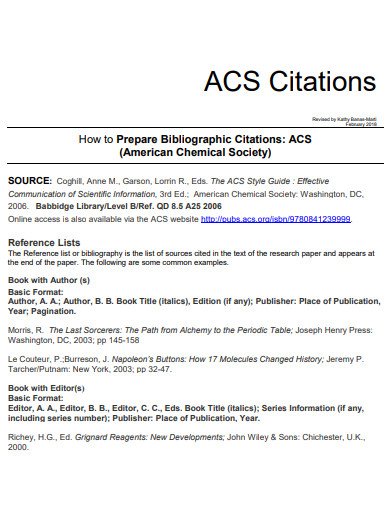
Navigating the labyrinth of citation styles can feel like a daunting task, especially when your research demands precision and adherence to specific academic standards. But for anyone contributing to the scientific community, particularly in chemistry and related fields, mastering the Introduction to ACS Citation Style isn't just a requirement; it's a fundamental part of clear, credible scientific communication.
The American Chemical Society (ACS) style is the gold standard for documenting sources in scientific research papers. It ensures consistency, clarity, and most importantly, traceability—allowing your readers to easily locate the original sources of information you've used. Think of it as a rigorous lab notebook for your intellectual journey, making every step transparent and verifiable.
At a Glance: Your ACS Citation Checklist
Before we dive deep, here’s a quick overview of what you’ll find in this guide:
- What is ACS Style? A brief on its purpose and prevalence in scientific writing.
- In-Text Citations: Three distinct methods for acknowledging sources within your paper.
- The Reference List: How to compile the definitive list of all your sources, placed at the end of your work.
- Detailed Examples: Comprehensive formats and real-world examples for common source types, from books to journal articles and websites.
- Best Practices: Tips for maintaining consistency, handling missing information, and ensuring accuracy.
The Cornerstone of Scientific Integrity: Understanding ACS Style
The American Chemical Society developed its style guide to provide a unified approach to writing, formatting, and citing sources within chemical literature. This consistency is vital in scientific fields, where replicating experiments, scrutinizing data, and building upon existing research are paramount. When you cite correctly in ACS style, you're not just avoiding plagiarism; you're actively participating in the scientific dialogue, crediting the intellectual lineage that underpins your own work, and enabling your peers to verify your claims.
ACS style dictates not only how you format your citations but also elements of manuscript preparation, from headings to tables and figures. For this guide, we'll focus specifically on the citation aspects—the in-text nods to your sources and the comprehensive reference list at your paper's conclusion.
In-Text Citations: Acknowledging Your Sources Mid-Sentence
Every time you incorporate another author's words, ideas, data, or theories into your paper, you must include an in-text citation. This signals to the reader exactly where that piece of information originated. ACS offers three primary methods for in-text citations, giving you flexibility based on journal requirements or personal preference:
- Superscript Numbers: This is perhaps the most common and concise method. A small, raised number appears directly after the cited material or at the end of the sentence before the punctuation.
- Example: "The novel compound demonstrated remarkable stability under varying thermal conditions.¹"
- Italic Numbers in Parentheses: Similar to superscript, but the number is italicized and enclosed in parentheses, placed at the end of the cited text.
- Example: "The reaction pathway exhibited a surprising intermediate product (2)."
- Author’s Name and Publication Date in Parentheses (Author-Date): This method explicitly names the author and year of publication. It's often favored when the author's identity or the timeline of research is particularly relevant to your discussion.
- Example: "Previous studies indicated a strong correlation (Smith, 2020)."
Key Rule for Numerical Citations (Superscript or Italic):
Assign a unique number to each source the first time you reference it. If you cite that same source again later in your paper, you use the original number assigned to it. The numbers should appear sequentially as they are introduced in your text. So, your first source is always "1," your second "2," and so on.
The Reference List: Your Source's Full Biography
While in-text citations provide a quick pointer, the reference list is where you give your readers the complete roadmap to your sources. This essential component appears at the very end of your paper, always starting on a new page. It provides all the necessary publication details for readers to find and verify your information.
How to Order Your Reference List:
The arrangement of your reference list directly depends on the in-text citation method you chose:
- For Superscript or Italic Numbers: Your reference list should be arranged numerically, in the order the sources first appeared in your paper. Reference "1" will be the first entry, "2" the second, and so forth.
- For Author-Date Citations: Your reference list should be arranged alphabetically by the last name of the primary author. If you have multiple works by the same author, list them chronologically, from oldest to newest.
Regardless of the ordering method, each entry in your reference list corresponds to an in-text citation and provides a comprehensive citation for that specific source. This dual system—in-text indicators coupled with a detailed reference list—forms the backbone of ACS citation style.
Remembering all the specific formatting rules for each source type can be challenging. Fortunately, there are tools to help streamline the process. Before you dive into the nuances of each citation type, consider exploring how a dedicated solution can simplify your workflow. You can Use our ACS format generator to ensure accuracy and save valuable time when drafting your papers.
Mastering the Details: Reference List Citation Examples
Now, let's break down the specific formats for the most common types of sources you'll encounter in your research. Pay close attention to punctuation, italics, and the order of elements – every detail matters in ACS style.
Books (with Primary Author(s))
For books with one or more primary authors, the format is quite detailed, including edition, publisher, location, and specific pages if you're only citing a portion.
- Basic Format: Author 1; Author 2; etc. Title of Book, Edition Number; Publisher: Location, Year; Volume number, pp Pages Used. DOI or aggregator URL (for ebook).
- Example: Le Couteur, P.; Burreson, J. Napoleon's Buttons: How 17 Molecules Changed History; Jeremy P. Tarcher/Putnam: New York, 2003; pp 32-47.
E-Books
Citing an e-book is similar to a print book, with the crucial addition of an "[Online]" tag, and access information.
- Basic Format: Author 1; Author 2; etc. Book Title [Online]; Series Information; Publisher: Place of Publication, Year; Volume Number, Pages Used. URL (accessed Month Day, Year).
- Example: Lo, K. K. Luminescent and Photoactive Transition Metal Complexes as Biomolecular Probes and Cellular Reagents [Online]; Springer: Berlin, 2015. (accessed Jan 19, 2020).
Authored Chapters in Books with Editor(s)
When you're citing a specific chapter within an edited book, you need to credit both the chapter author(s) and the book editor(s).
- Basic Format: Author, A. A.; Author, B. B. Chapter Title. In Book Title; Editor, A. A., Editor, B. B., Eds.; Series Title (if any), Volume number (if any); Publisher: Place of Publication, Year; Volume number (if any), Page numbers (pp __-__ ). DOI or aggregator URL (for ebook).
- Example: Downs, G. M.; Barnard, J. M. Clustering Methods and Their Uses in Computational Chemistry. In Reviews in Computational Chemistry, Vol. 18; Lipkowitz, K. B., Boyd, D. B., Eds.; Wiley, 2002, pp 1-40.
Books with Editor(s), Entire Book Referenced
If you're referencing an entire book that has editors rather than primary authors, the format shifts to emphasize the editors.
- Basic Format: Book Title; Editor, A. A., Editor, B. B., Eds.; Series Information (if any, including series number); Publisher: Place of Publication, Year. DOI or aggregator URL (for ebook).
- Example: Polymers for Microelectronics and Nanoelectronics; Lin, Q., Pearson, R. A., Hedrick, J. C., Eds.; ACS Symposium Series, Vol. 874; American Chemical Society: Washington, DC, 2004.
Encyclopedia or Handbook Articles (Print)
For print encyclopedias or handbooks, you'll need the article title, the encyclopedia name, edition, publisher, and specific page numbers.
- Basic Format: Article Title. In Encyclopedia Name, Edition number; Publisher: Place of Publication (optional), Year; Volume Number, Page numbers and/or other identifiers.
- Example: Psychopharmacological Agents. In Kirk-Othmer Encyclopedia of Chemical Technology, 4th ed.; Wiley, 1996; Vol. 20, pp 455-457.
Online Encyclopedias, Handbooks and Dictionaries
Online reference works require a URL and the date you accessed the information, as content can sometimes be updated.
- Basic Format: Encyclopedia or Handbook or Dictionary Title, edition; Publisher, Posted Online Posting Date (if available). DOI or URL (accessed YYYY-MM-DD). Other identifiers.
- Example: CRC Handbook of Chemistry and Physics, 105th ed.; Rumble, J. R., Ed.; CRC Press, 2023. https://hbcp.chemnetbase.com/documents/07_13/07_13_0001.xhtml?dswid=-7713 (accessed 2025-03-03).
Magazine or Newspaper Articles
These sources provide current perspectives and are cited with author, article title, periodical title, full date, and page numbers.
- Basic Format: Author 1; Author 2; etc. Title of Article. Title of Periodical, Complete Date, Pages.
- Example: Manning, R. Super Organics. Wired, May 2004, pp 176-181.
- Notes:
- For newspapers, include "p." or "pp." before page numbers (e.g., pp 176-181).
- If pages are not continuous, list all separated by a comma.
- If retrieved online, include "Retrieved from" and the URL.
Scholarly Journal Articles (Print)
Journal articles are the backbone of scientific research. For print journals, a concise format including author(s), article title, abbreviated journal title, year, volume, and page numbers is used.
- Basic Format: Author 1; Author 2; etc. Title of Article. Journal Abbreviation Year, Volume, Pages.
- Example: Evans, D. A.; Fitch, D. M.; Smith, T. E.; Cee, V. J. Application of Complex Aldol Reactions to the Total Synthesis of Phorboxazole B. J. Am. Chem. Soc. 2000, 122, 10033-10046.
Scholarly Journal Articles (Online)
Most journal articles are now accessed online. The format for online articles includes an "[Online]" tag, issue number (if applicable), and URL/DOI.
- Basic Format: Author, A. A.; Author, B. B.; Author, C. C. Title of Article. Journal Abbreviation [Online] Year, Volume(Issue Number), Page numbers or Article number (if online only). Complete URL (accessed Date). DOI: 10.xxxx/etc. Database Name (if accessed via database).
- Example (Open Web): Peacock-Lopez, E. Exact Solutions of the Quantum Double Square-Well Potential. Chem. Ed. [Online] 2007, 11, 383-393. (accessed Dec 6, 2018).
- Example (Library Database): Begley, S. When Does Your Brain Stop Making New Neurons? Newsweek [Online] July 2, 2007, p 62. Expanded Academic Index. (accessed Aug 23, 2007).
- Example (with DOI): Kuchenreuther, J. M.; Britt, R. D.; Swartz, J. R. New Insights into [FeFe] Hydrogenase Activation and Maturase Function. PLoS One 2012, 7(9), e45850. DOI: 10.1371/journal.pone.0045850.
- Note: The standard list of journal abbreviations, critical for conciseness, is available in the official ACS Style Guide. Always refer to this guide for definitive abbreviations.
Websites
Citing websites requires careful attention to the author (if available), title of the specific page, title of the overall website, publication/update date, and the URL with access date.
- Basic Format: Author, X (if any). Title of webpage. Title of website, date of publication/last updated (if available). URL (accessed Month Day, Year), other identifying information (if any).
- Example: National Library of Medicine. Environmental Health & Toxicology. (accessed Feb 04, 2020).
- Example (with date): Scalfani, V. Computing InChIs. IUPAC FAIR Chemistry Cookbook, February 14, 2024. https://w3id.org/ifcc/IFCC012 (accessed 2025-03-03).
- Note: Do not include session-specific URLs for subscription sites. Always aim for the stable, persistent URL.
Navigating Common Pitfalls and Ensuring Accuracy
Even with clear guidelines, citation can present challenges. Here are a few expert tips to help you maintain accuracy and avoid common errors:
- Consistency is Paramount: Once you choose an in-text citation method (superscript, italic numbers, or author-date), stick with it throughout your entire paper. The same goes for formatting nuances within your reference list. Inconsistency is a major red flag for reviewers.
- Handle Missing Information Gracefully: Sometimes a source might be missing an author, publication date, or even a clear title. In such cases, ACS style provides guidance (e.g., using "Anon." for anonymous authors, or describing the source if no title exists). Prioritize providing as much information as possible to help a reader locate the source.
- DOIs Over URLs: Whenever possible, use a Digital Object Identifier (DOI) for online journal articles and other scholarly content. DOIs are persistent identifiers and are more reliable than URLs, which can change over time. If a DOI is available, include it even if you also provide a URL.
- Check Journal Requirements: While this guide covers the core ACS style, individual journals sometimes have minor variations or specific instructions. Always consult the "Author Guidelines" or "Instructions for Authors" of your target journal before submission.
- Utilize Citation Management Tools: Software like Zotero, Mendeley, or EndNote can automatically format your citations and reference lists in ACS style. While these tools are incredibly helpful, always double-check their output against the official ACS Style Guide, as errors can occur, especially with unusual source types.
- Proofread Meticulously: A misplaced comma, an incorrect year, or a misspelled author name can undermine the credibility of your citations. Treat your reference list with the same meticulous attention to detail you apply to your experimental data.
Your Next Steps: Embracing ACS Style with Confidence
Mastering the ACS citation style is an ongoing process, but by understanding the fundamental principles and paying close attention to the specific formats, you're well on your way to producing professional, credible scientific papers. Remember, the goal isn't just to follow rules; it's to enhance the clarity and integrity of your research for the global scientific community.
Keep this guide handy as you write and revise. Practice citing different source types, and don't hesitate to consult the official ACS Style Guide for any specific edge cases or detailed questions. With practice, accurate ACS citation will become second nature, allowing you to focus more on the groundbreaking science you're sharing with the world.