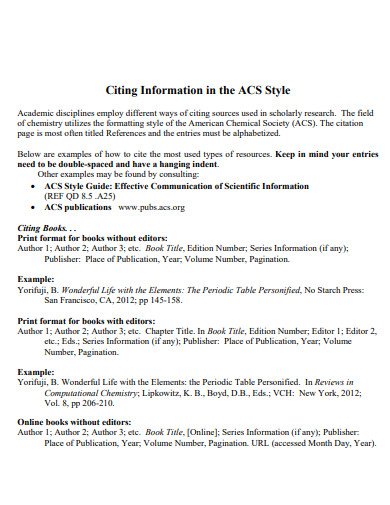
Navigating the intricacies of academic citation can often feel like deciphering a complex chemical formula – one misplaced comma or a forgotten italic, and your entire experiment (or paper) could be compromised. For anyone immersed in the world of chemistry, mastering Citing Specific Source Types in ACS Format isn't just a nicety; it's a fundamental skill, a cornerstone of scholarly communication that ensures transparency, integrity, and reproducibility.
The American Chemical Society (ACS) style, as laid out in the 3rd Edition of The ACS Guide to Scholarly Communication, provides a clear, consistent framework for citing sources. It’s designed to bring order to the vast and ever-evolving body of chemical literature, allowing readers to easily locate the original research you're building upon. Forget rote memorization; our goal here is to equip you with the understanding to apply ACS principles confidently, ensuring your references are as precise as your experiments.
At a Glance: Your ACS Citation Checklist
- Two-Part System: Every citation involves a brief in-text mention and a detailed reference list entry.
- Consistency is Key: Choose one in-text citation method (superscript numbers, italicized parenthetical numbers, or author-date) and stick with it throughout your paper.
- Reference List Details: Start on a new page, titled "References." Use hanging indents for each entry.
- Order Matters: Numerically by first appearance for numerical in-text citations, or alphabetically by author for author-date.
- Specific Formats: Books, journal articles, patents, online sources—each has its own precise structure.
- Mind the Details: Pay close attention to bolding, italics, punctuation, capitalization, and access dates for online sources.
The Foundation: Why ACS Style?
In the fast-paced realm of chemical research, clarity and precision are paramount. ACS style serves as the lingua franca, standardizing how scientists acknowledge previous work, allowing for easy navigation and verification. Imagine trying to replicate a complex synthesis without knowing precisely which journal article described the original method! The ACS guidelines provide that crucial roadmap, fostering a culture of rigorous scholarship and preventing issues like plagiarism.
Before diving into specific source types, let's nail down the overarching structure: every ACS citation is a two-part dance. First, you briefly acknowledge a source within your text. Second, you provide its full bibliographic details in a dedicated "References" section at the end of your paper.
Crafting Your In-Text Mentions: Three Ways to Acknowledge
The ACS style offers flexibility with its in-text citations, but the golden rule is consistency. Pick one method and adhere to it without deviation.
1. The Superscript Numbers: Traditional & Concise
This is perhaps the most common method, especially in printed ACS publications. When you introduce information from a source, you'll place a superscript number at the point of reference.
- How it Works:
- Number your sources consecutively (1, 2, 3...) as they first appear in your paper.
- If you cite the same source again, reuse its original assigned number.
- Place the number within or at the end of a sentence, typically after punctuation.
- Example: "The novel catalyst demonstrated enhanced efficiency in a recent study.¹ Smith and Johnson¹ later explored..."
2. The Italicized Parenthetical Numbers: Digital-Friendly
Growing in popularity for digital publications, this method uses numbers enclosed in italicized parentheses. These are often clickable links in online articles, leading directly to the corresponding reference.
- How it Works:
- Similar to superscripts, sources are numbered consecutively based on their first appearance.
- The numbers are italicized and placed within parentheses.
- Example: "The reaction achieved 95% yield (3)." or "Further analysis confirmed these findings (1, 4, 5)."
3. The Author-Date System: Less Common, But Available
While less frequently seen in core chemistry journals, the author-date system is a valid ACS option. It integrates the author's last name and the publication year directly into your prose.
- How it Works:
- Single Author: Include the author's last name and the publication year in parentheses. Example: "Brown (2020) demonstrated a new approach..."
- Two Authors: Use "and" between their last names. Example: "Rakita and Smith (2018) reported that..." or "(Rakita and Smith, 2018)."
- Three or More Authors: Use the first author's last name followed by "et al." (meaning "and others"). Example: "Chen et al. (2021) observed a significant shift..." or "(Chen et al., 2021)."
- No Author: Use the title of the work (or a shortened version) and the year. Example: "The properties of novel materials were discussed (Catalyst Applications, 2020)."
Placing Your In-Text Citations
Regardless of the method, position your citation where the information is mentioned. Often, this is at the end of a sentence, after the punctuation, or strategically within the sentence to attribute specific claims. When citing multiple sources for a single point, list their numbers in ascending order (e.g., ¹,²,³ or (1, 2, 5)).
Building Your "References" Section: The Full Story
The "References" section is where you provide the complete bibliographic details for every source you've cited in your text. This is crucial for your readers to find and verify your sources.
General Formatting Guidelines
- New Page: Always begin your "References" section on a separate page.
- Heading: Title the page simply "References." It should be centered or left-justified, without bolding or italics.
- Hanging Indent: Each entry in your reference list must use a hanging indent. This means the first line of the citation is flush with the left margin, and all subsequent lines are indented. This visual cue makes it easy to distinguish individual entries.
- Required Components: While specific source types vary, every entry needs at least the Author or Editor, Publication Date, and Publication Information (e.g., article title, journal title, book title, publisher details).
- Accuracy Check: Before submitting, meticulously cross-reference every in-text citation with its corresponding reference list entry. Are all details correct? Is every in-text citation represented in the list, and vice-versa?
Ordering Your References
The method you chose for in-text citations dictates how your "References" list is ordered:
- For Numerical In-Text Citations (Superscript or Italicized Parenthetical):
- Order your references numerically based on their first appearance in the text. This means the source cited as ¹ in your paper will be the first entry in your "References" list, ² will be the second, and so on.
- For Author-Date In-Text Citations:
- Order your references alphabetically by the last name of the first author.
- Multiple references by the same author/first author:
- Single-author references come first, arranged chronologically (earliest publication first).
- Then, two-author citations (alphabetize by the second author's last name).
- Finally, group citations (first author followed by "et al.").
- Same author(s) and same date: Arrange these chronologically by the title and add lowercase letters (a, b, c) immediately after the date in both the in-text citation and the reference list (e.g., Smith, 2020a; Smith, 2020b).
- Same first author, different co-authors: These entries come after all single-author entries for that first author. Then, order them chronologically and alphabetize by the first initial of the co-authors.
Dissecting a Reference Entry: The Building Blocks of Detail
Each component within a reference list entry has specific formatting rules. Get these right, and you're halfway to an ACS-perfect paper.
- Authors:
- Always invert names: Last Name, Initials. (e.g., Smith, J. A.; Johnson, M. B.).
- List all authors in the order they appear on the original document.
- Separate multiple authors with semicolons.
- Publication Date:
- Scholarly Journals: The year is bolded (e.g., 2023).
- Nonscientific Magazines/Newspapers: Provide the exact date (abbreviated month, day, year). The year is not bolded.
- Books: The year is not bolded.
- Titles:
- Journal Article Titles: Capitalize the main words of titles and subtitles. Do not use quotation marks or italics. End with a period.
- Journal Titles: Italicize the journal title. Use official abbreviations found in the Chemical Abstracts Service Source Index (CASSI).
- Book Titles: Italicize the title and any subtitle. Use title case (capitalize main words). End with a semicolon if more information follows, otherwise a period.
- Volume/Pagination:
- Journals/Magazines/Newspapers: Italicize the volume number. If an issue number is available, place it in parentheses immediately after the volume number (e.g., 123(4)) – the issue number itself is not italicized. Follow with a comma and then the complete page range (no commas or spaces within the page numbers, e.g., 567-578).
- Online Articles: If a Digital Object Identifier (DOI) is available, include it. Otherwise, provide the full URL and the access date (Month Day, Year).
- Publisher Information (Books):
- Include the publisher's name (normal typeface, followed by a colon).
- Provide the place of publication (city, state for US publishers; city, country for non-US publishers). Follow with a comma.
- Finally, the year of publication (normal typeface).
- End with a period or semicolon if additional information (like page numbers for a chapter) follows.
Your Essential Guide: Citing Specific Source Types in ACS
Now, let's get to the practical examples. Below are common source types you'll encounter and their precise ACS reference formats.
1. Book
For an entire book, you need the author(s), title, publisher, and publication details.
- Template: Last Name, Initials.; Last Name, Initials. Book Title; Publisher: City, Year.
- Example: Smith, J. A.; Johnson, M. B. Organic Chemistry Basics; XYZ Press: Boston, 2022.
2. Book Chapter
When you're citing a specific chapter within a larger edited book, you'll need details for both the chapter and the book itself.
- Template: Last Name, Initials. Chapter Title. In Book Title; Editor's Last Name, Initials, Ed.; Publisher: City, Year; pp Page Range.
- Example: Brown, R. P. Organic Chemistry Reactions. In Chemical Analysis Explained; Johnson, M. B., Ed.; XYZ Publishers: New York, 2021; pp 123-145.
3. Journal Article
This is arguably the most common source type in chemical literature. Pay close attention to the journal abbreviation, bolded year, and italicized volume.
- Template: Last Name, Initials.; Last Name, Initials. Article Title. Journal Abbreviation Year, Volume(Issue), Page Range.
- Example: Williams, S. C.; Anderson, R. E. Recent Advances in Chemical Kinetics. J. Phys. Chem. B 2019, 123(4), 567-578.
4. Lab Manual
Whether it's a published manual or one provided by your instructor, proper attribution is essential for experimental procedures.
- Template: Last Name, Initials. Manual Title; Publisher: City, Year.
- Note: If the manual is instructor-authored for a university course, list the instructor as the author and the university as the publisher.
- Example: Davis, L. K. Experimental Chemistry: A Guide to Lab Techniques; ABC Publishers: Chicago, 2020.
5. Encyclopedia Entry
For specialized information found in encyclopedias, cite the specific entry and the larger work.
- Template: Last Name, Initials. Entry Title. In Encyclopedia Title; Publisher: City, Year; pp Page Range.
- Example: White, E. L. Chemical Reactions. In Encyclopedia of Chemistry; XYZ Press: Sydney, 2022; pp 45-89.
6. Thesis or Dissertation
These valuable sources of original research often contain unique data and methodologies.
- Template: Last Name, Initials. Thesis Title. Ph.D. thesis (or M.S. thesis), University Name, City, Year.
- Example: Garcia, A. M. Synthesis of Novel Organic Compounds; Ph.D. thesis, University of California, Berkeley, 2020.
7. Patent
Patents describe inventions and can be critical references for applied chemistry.
- Template: Last Name, Initials.; Last Name, Initials. U.S. Patent PatentNumber B2 (or A1, A2, etc., depending on the patent type), Issue Date.
- Example: Johnson, M. B.; Smith, J. A. U.S. Patent 9,876,543 B2, April 25, 2023.
8. Conference Paper
Citing presentations or papers from conferences acknowledges cutting-edge research before it might appear in peer-reviewed journals.
- Template: Last Name, Initials.; Last Name, Initials. Paper Title. Presented at the Conference Name, City, Year.
- Example: Anderson, R. E.; Brown, R. P. Chemical Synthesis Advances. Presented at the American Chemical Society National Meeting, Chicago, 2023.
9. Technical Report
These reports from organizations or government agencies provide specialized information, often on experimental or developmental work.
- Template: Last Name, Initials.; Last Name, Initials. Report Title. Technical Report No. ReportNumber, Organization, Year.
- Example: Smith, J. A.; Davis, L. K. Techniques for Chemical Analysis; Technical Report No. TR-456, XYZ Research Institute, 2021.
10. Online Article / Website Content
For sources accessed exclusively online, particularly if they don't fit the journal article format, you must include the URL and the date you accessed the information. For online journal articles, the format is similar to print, but includes online access details.
- Template (Online Journal Article): Last Name, Initials. Article Title. Journal Abbreviation Year, Volume(Issue), Page Range. URL: WebsiteLink (accessed Month Day, Year).
- Example: Wilson, P. Q. Green Chemistry Innovations. Chemistry Today 2021, 10(3), 23-30. URL: https://www.chemistrytoday.com (accessed Jan 15, 2022).
- Note: For general websites or online documents without a specific "journal" context, adapt the template to include author (if available), title, organization, URL, and access date. Prioritize DOIs over URLs when present.
11. Computer Program / Software
When a specific software or program is crucial to your methodology or results, it warrants a citation.
- Template: Last Name, Initials. Program Title. Software, Version Number, Year.
- Note: If specific data within the program is referenced, include that data entry number.
- Example: Johnson, M. B. Molecular Dynamics Simulator; XYZ Software, Version 2.0, 2023.
Navigating the Pitfalls: Common ACS Citation Mistakes & How to Dodge Them
Even seasoned researchers can stumble over citation details. Being aware of common missteps is your first line of defense.
- Inconsistent Author Listings: Always use the "Last Name, Initials." format (e.g., Smith, J. A.) and separate multiple authors with semicolons in your reference list. Don't mix formats (e.g., "John Smith" and "Smith, J.").
- Omitting Key Information: A common culprit! Double-check that all necessary details—volume, issue, page range, DOI or URL, publisher, year, and crucially, access date for online sources—are included for each entry. A missing piece makes your source untraceable.
- Improper Use of Italics: This is a tricky one. Only journal names and book titles get italicized. Article or chapter titles, volume numbers, and page ranges should not be in italics.
- Incorrect Punctuation and Capitalization: Follow ACS rules precisely. Article titles use sentence case (capitalize main words), while journal and book titles use title case. Periods, commas, and semicolons are placed very deliberately.
- Forgetting Access Date: This is a non-negotiable for any online source. Websites can change or disappear, so the access date provides a timestamp for the information you retrieved.
- Misplacing Page Numbers: Ensure correct and complete page ranges are provided (e.g., 23-30, not just 23). For book chapters, the page range typically appears at the end of the entry, not within the book title.
The Secret to Seamless Referencing: Beyond the Manual
While understanding the rules is essential, applying them flawlessly, especially with a long list of references, can be time-consuming. That's where tools and habits come in. Consider leveraging our ACS format generator to streamline the process, ensuring accuracy and saving precious time. These tools can help you generate correct citations, minimizing the risk of errors that could detract from the professionalism of your work.
Moreover, cultivate habits like saving full citation information as you research. Don't wait until the last minute to compile your reference list. Keep a running tally of your sources and their details to avoid frantic searches later on.
Achieving ACS Mastery: Your Path to Confident Communication
Mastering ACS citation isn't about memorizing every last comma; it's about understanding the logic behind the system and knowing where to find the answers when you're unsure. The ultimate goal is to present your research with clarity, integrity, and professionalism, allowing your scientific contributions to stand on their own merit. By consistently applying these guidelines, you're not just fulfilling a requirement; you're upholding the standards of scientific discourse and contributing to a more transparent and reproducible body of knowledge. Your precision in the lab should be matched by your precision on the page.